Finding Freedom Within Structure: A Branch Weaving Project
Sometimes the best learning happens when we give students a framework and then step back to see what they create. That’s what happened with our recent tree branch weaving project, inspired by educator Marnii Sclaroff.

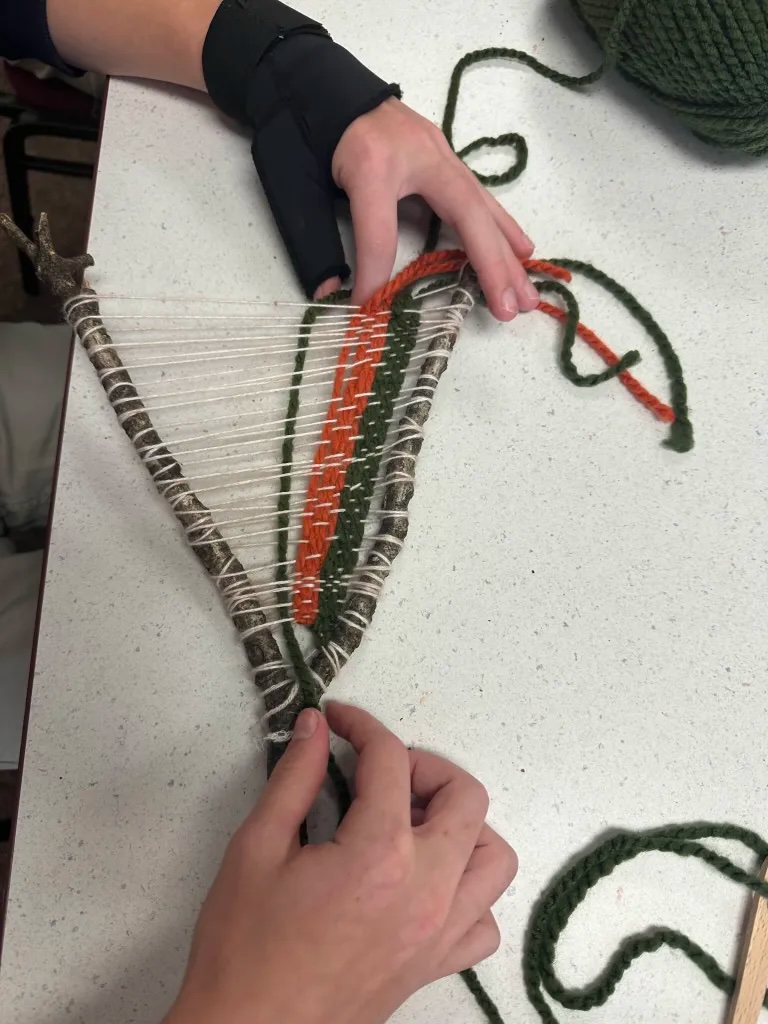
The concept is beautifully simple, but the execution offers room for discovery. You start by finding a sturdy V-shaped tree branch – or in our case, a larger branch with three sturdy V-shapes. My original vision was ambitious: have the students weave the entire branch as one piece, creating a fall tree around four feet tall. But as they got into the work and became involved in their teams, we realized we needed to separate the branches. Sometimes the project teaches you as much as it teaches the students.
To warp the branch loom, you start at the bottom by tying an end of sturdy yarn (any yarn works, though there is special warp loom yarn available). Cross the expanse between the V and wrap the opposite side twice before bringing the thread back across. Continue this process until you reach the top, creating the foundation for your weaving.
The next step is where creativity takes over: weaving over and under the warped threads. A tapestry needle makes this process much easier. Here students can experiment with skip patterns, vary the tension of their weave, and play with color. We chose rich oranges, yellows, reds, and greens to represent the coming autumn season. It’s best to start at the top and weave down to the bottom, then back up again. Students should ideally use a weaving comb to push their woven threads down toward the end to make the weave tight, though of course they may want to play with different tensions for artistic effect. Once you finish with a yarn color or pattern, you can weave the fringes into the edges – or, as my students discovered, create decorative knots along the sides.
Unlike traditional weaving on a rigid loom, branch weaving offers an invitation to improvisation. The warp you create is rarely exactly what you envisioned. The branch dictates some of the terms. And yet, within those constraints, each student found their own way to weave the pattern they wanted.
There’s a metaphor about life in there somewhere, I’m sure of it. We don’t always get the circumstances we’d choose, but we can still create something beautiful with what we’re given. The “loom” we inherit – whether it’s a curved branch or life’s unexpected turns – doesn’t have to limit us; it can guide us toward patterns we never would have discovered otherwise.
But the learning didn’t stop with the tactile experience. To deepen their understanding, I sent students videos and articles about fabric, weaving, and the plant domestication that made textile arts possible. Virginia Postrel’s book The Fabric of Civilization offers a fascinating look at how weaving shaped human history, technology, and culture – transforming this hands-on project into a gateway for exploring agriculture, innovation, and the interconnectedness of human achievement.
Every student left with a unique woven piece and, I hope, an appreciation for how creativity thrives within constraints.
Weaving Vocabulary:
-
Warp: The foundational threads set up lengthwise on the loom (wrapped around your branch)
-
Weft: The threads woven over and under the warp threads
-
Warping: The process of creating the warp foundation on your loom
Supplies Needed:
-
V-shaped branch
-
Warping yarn
-
Scissors
-
Tapestry needle
-
Weaving comb
-
Your favorite colored yarn
Opinions expressed by individual writers in this blog do not necessarily reflect the views of the Board of Directors of The Organization of Virginia Homeschoolers, nor do they represent an official position of VaHomeschoolers. Writers’ views are their own, and readers are encouraged to research and explore homeschooling issues to their own satisfaction.